


Home / Resources / Technical Articles & White Papers / Flux-cored wires in industrial welding applications
Flux-cored wires in industrial welding applications
Across heavy industry, welding is not only about joining metals. Very often, it is about keeping production running, reducing downtime, and extending the service life of critical components operating under severe conditions.
At Welding Alloys, the objective is not simply to supply welding consumables. The focus is to help customers solve industrial challenges through practical and reliable welding solutions adapted to real operating conditions.
Flux-cored wires are a key part of this approach. Over the years, they have progressively replaced stick electrodes and, in many applications, solid wires, as companies look to improve productivity, weld quality and process stability.
Today, they are widely used for hardfacing, rebuilding, crack repair, stainless steel joining and cladding applications, offering faster welding operations without compromising performance.
WHY FLUX-CORED WIRES ARE DIFFERENT
Unlike solid wire, flux-cored wire is tubular. It consists of a metal sheath filled with powders containing alloying elements, fluxes, slag formers, arc stabilisers, and deoxidisers. This tubular design gives manufacturers greater flexibility when developing consumables for specific industrial applications. Depending on the application, the composition inside the wire can be adjusted to achieve targeted properties, such as specific chemical analysis and hardness, while taking the base metal chemistry and the number of deposited layers into account.
This technology also allows the development of cored wires for a wide range of welding processes and applications, including self-shielded and gas-shielded flux-cored arc welding (FCAW-S and FCAW-G), submerged arc welding (SAW) and laser wire applications.
Two main types of flux-cored wire are commonly used in industry: folded cored wires and seamless cored wires.
- Folded cored wires are manufactured from a formed steel strip filled with powder before the wire is closed. This method is widely used because it offers high production flexibility and allows a wide variety of alloy systems and wire designs.
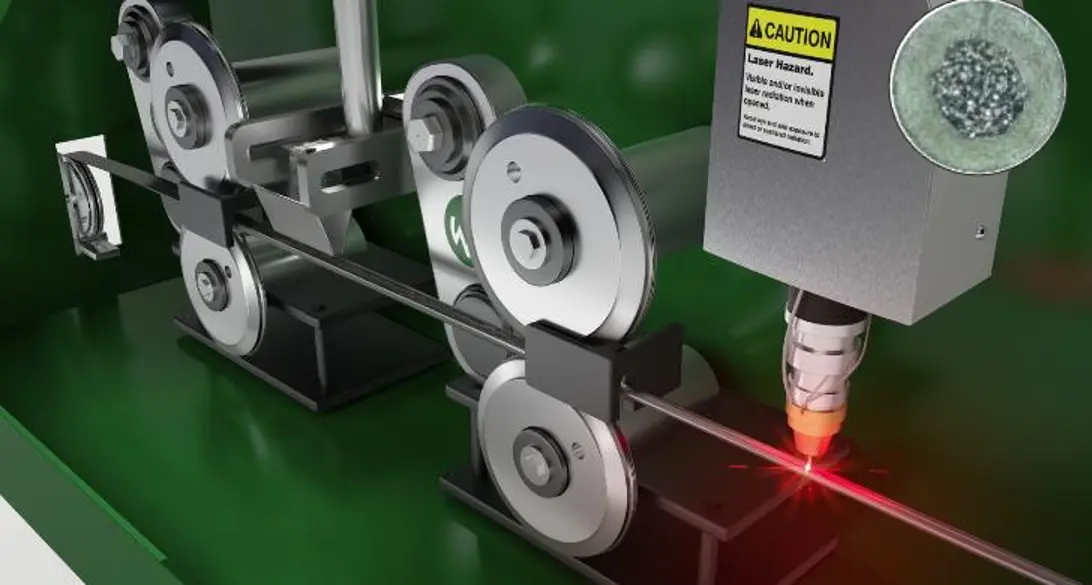
- Seamless cored wires are produced by forming a steel strip into a U-shape, accurately filling it with a precisely controlled powder mixture, then hermetically sealing the tube by laser welding before it is drawn to its final This sealed design helps reduce moisture absorption and hydrogen pick- up, improving storage stability, feeding consistency and welding reliability.
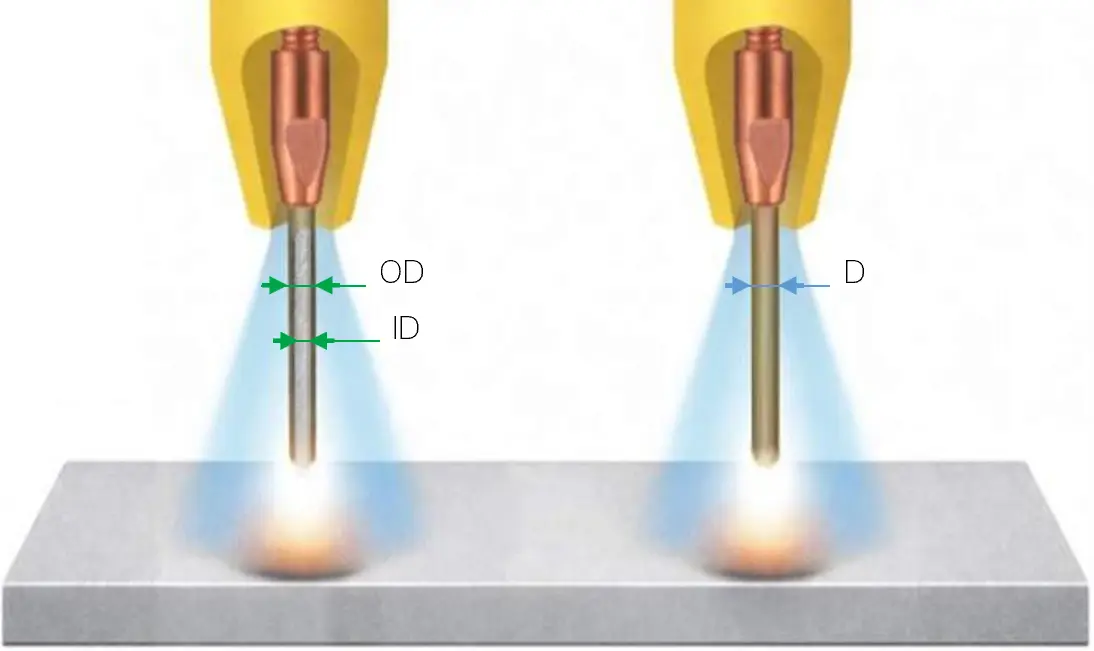
With cored wires, whether folded or seamless, most of the current travels through the outer metal sheath. This increases current density and allows the wire to heat and melt more efficiently than a solid wire of the same diameter.
In practical terms, these characteristics allow cored wires to achieve high deposition rates, stable arc behaviour and efficient welding conditions.
FLUX-CORED WIRES VERSUS STICK ELECTRODES
In repair and maintenance welding, productivity is often critical because welding time directly affects shutdown duration and production losses.
Stick electrodes remain useful for small repairs, restricted access areas and certain site applications. However, the process involves frequent interruptions, as the welder must regularly stop to change electrodes, restart the arc and remove slag between passes.
Flux-cored wires are fed continuously from a spool or drum, greatly reducing these interruptions. This means the process is no longer fully manual, but semi-automatic or automatic, depending on the equipment used.
This becomes especially important during large hardfacing and rebuilding operations, such as kiln tyre repairs in the cement industry, where shutdown time must be kept to a minimum. It is also relevant for smaller jobs, such as hardfacing rail crossings, where reducing welding time helps limit the welder’s exposure to uncomfortable working positions, welding fumes and heat.
- One of the main differences is deposition FCAW typically achieves deposition rates of around 4-8 kg/h, compared with approximately 1-3 kg/h for shielded metal arc welding (SMAW). In real maintenance conditions, this allows repairs to be completed much faster, while reducing labour time and maintenance shutdown duration.
- Deposition efficiency is also much higher with flux-cored FCAW typically achieves deposition efficiencies of around 90-98%, with the remaining loss mainly linked to slag, while SMAW is generally around 55-65% due to electrode stub losses and slag formation.
In a cored wire, the metal section that carries the current is smaller than in a solid wire of the same diameter. This increases current density and electrical resistance, promoting faster wire melting and allowing efficient welding conditions while keeping heat input under control.
In practice, this improves productivity during fabrication and cladding operations.
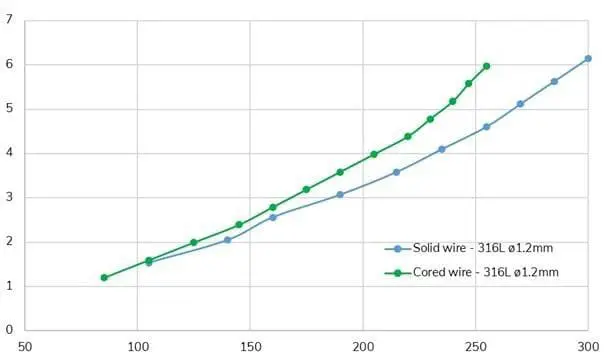
Comparison of current and deposition rate showing the higher deposition capability of flux-cored wires
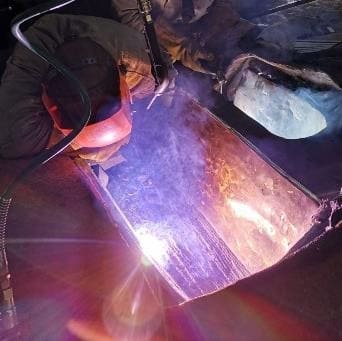
Semi-automatic repair of a cement kiln tyre using the GAMMA 182 nickel-based flux-cored wire, providing high deposition rates and reduced shutdown time.
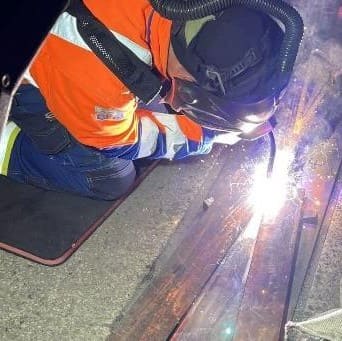
Hardfacing repair of an embedded tramway crossing using the HARDFACE 19 9 6-O work-hardening austenitic manganese steel flux-cored wire.
FLUX-CORED WIRES VERSUS SOLID WIRES
In stainless steel fabrication and cladding applications, solid wires remain widely used. Modern power sources now offer well-developed synergic programmes, which help simplify parameter setting and make the welding process easier to control. As a result, users no longer face the same welding challenges they faced in the past.
However, gas-shielded flux-cored wires are increasingly used where higher productivity, better positional welding performance, and greater process flexibility are required.
Because of their tubular structure, cored wires generally deposit more weld metal per hour than solid wires at similar current levels.
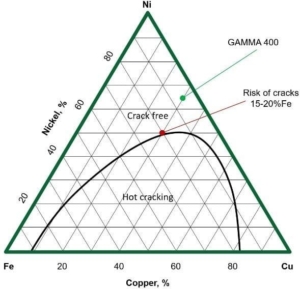
Diagram for hot-cracking susceptibility of iron-diluted nickel- copper alloys
Gas-shielded flux-cored wires are also particularly effective in positional welding. The slag system helps control and stabilise the molten weld pool, making it easier to weld in vertical and horizontal positions while maintaining relatively high deposition rates.
This is especially valuable for stainless steel tanks, pipe fabrication, pressure vessels, process equipment, and on-site repair work where welding conditions are not always ideal.
Compared with solid wires, flux-cored wires also tend to produce wider weld beads and smoother bead profiles under similar conditions.
In cladding applications, controlling dilution and deposit chemistry is critical. Flux-cored wires are particularly well suited for this because the internal formulation of the wire can be adjusted very precisely to achieve targeted weld metal properties.
This development is a good example of how cored wire technology can help solve practical industrial challenges by combining productivity, weld quality, and simplified welding procedures.
A good example of the flexibility offered by flux-cored wire technology is GAMMA 400, a basic flux-cored wire designed for ALLOY 400 (Ni-Cu) applications.
Cladding with solid Ni-Cu wires can be difficult, as dilution with iron from the carbon steel substrate can significantly increase the risk of hot cracking. For this reason, a pure nickel buffer layer was often required before depositing the final ALLOY 400 overlay.
With GAMMA 400, the flux-cored wire design helps control and reduce dilution. This makes it possible to achieve the target ALLOY 400 chemical analysis in only two layers, without requiring a dedicated pure nickel buffer layer.
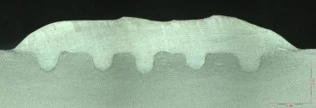
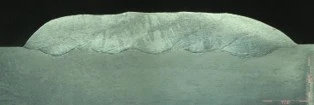
Comparative cladding trials on carbon steel using N04400 consumables were carried out at approximately 215 A, 26 V and 29 cm/min travel speed. Under these conditions, GAMMA
400 achieved significantly lower first-layer dilution than pulsed GMAW using solid wire, with measured values of around 13% and 23% respectively, corresponding to iron contents of approximately 9% and 15%.
A PRACTICAL APPROACH TO INDUSTRIAL WELDING
There is no single welding solution for every application.
Stick electrodes remain useful for certain repair situations, particularly where portability, accessibility, or all-position welding are required.
Solid wires can also be the right choice for standard applications where specific control over dilution or heat input is not critical, or where advanced power source technologies with controlled short-arc, pulsed MIG/MAG, or advanced waveform programmes make the process easier to manage.
However, for many repair, maintenance, hardfacing and stainless steel cladding applications, flux-cored wires offer a strong balance of productivity, reliability, flexibility and welding performance.
Most importantly, they help customers to reduce downtime, improve maintenance efficiency and extend the service life of critical industrial equipment.
At Welding Alloys, this practical, field-based approach remains central. The objective is always to work closely with customers and provide welding solutions designed to address real industrial challenges under real operating conditions.
Watch a short comparison video between FCAW and SMAW using advanced nickel- based consumables ENiCrFe3, clearly showcasing the key productivity advantages of flux-cored wire technology.