

Home / Resources / Technical Articles & White Papers / Extending continuous casting roll performance CHROMECORE 414NX
Extending continuous casting roll performance CHROMECORE 414NX
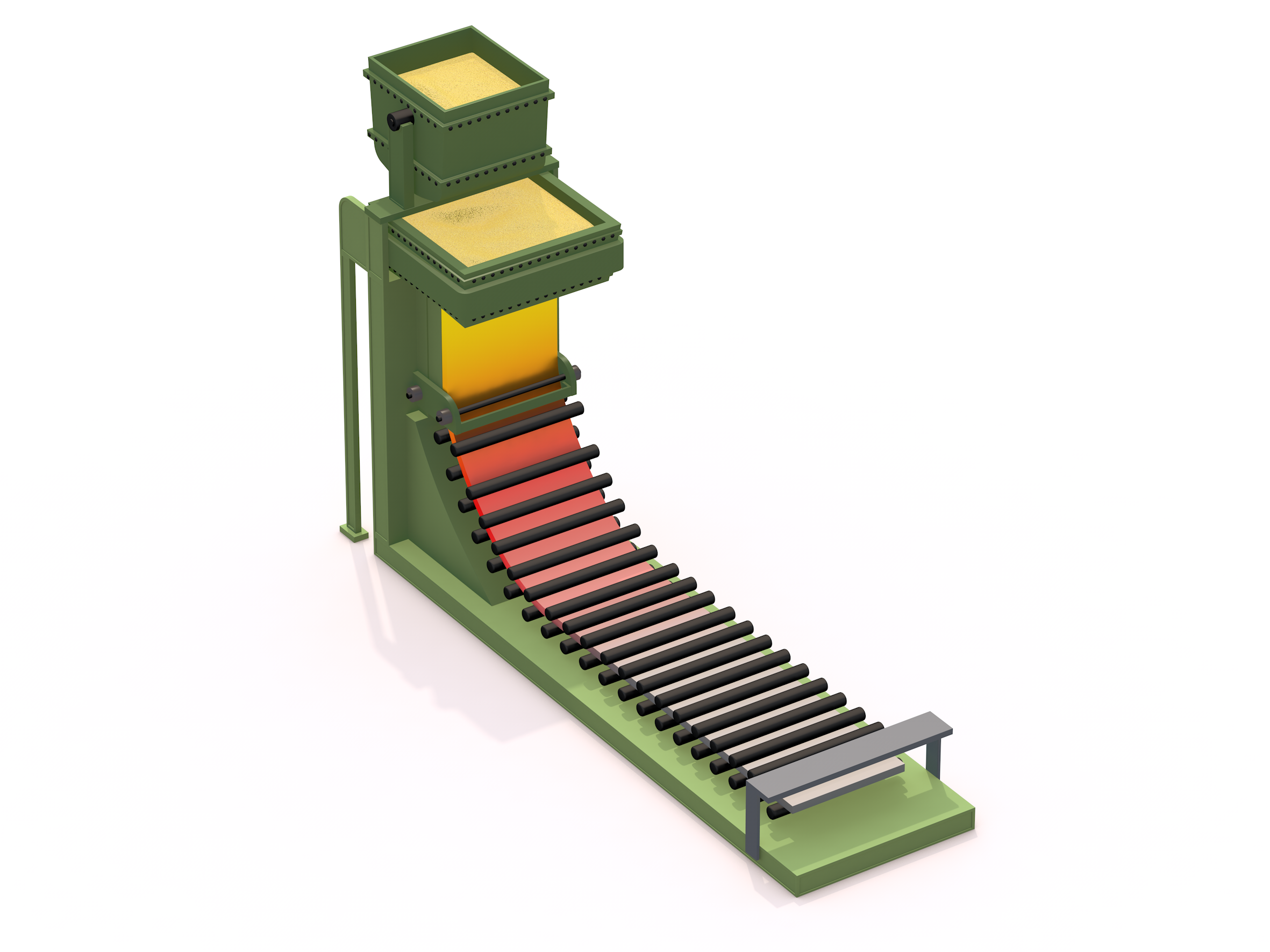
The rolls used in continuous casting lines operate under demanding conditions, where several degradation mechanisms can act simultaneously. From the high-temperature area directly below the mould to the straightening and horizontal segments, rolls are exposed to different combinations of temperature, thermal cycling, corrosion, abrasion, metal-to-metal contact, mechanical stresses and contact pressure. As the strand moves through the continuous casting line and progressively cools, the relative influence of these mechanisms changes.
This is why different cladding alloys are used according to roll position. The objective is not simply to provide a hard surface, but to match the metallurgy and properties of the weld deposit to the main degradation mechanisms encountered in service.
As steel producers continue to increase productivity while maintaining tight control over product quality, improving roll reliability and service life remains an important challenge.
At Welding Alloys, this understanding of roll degradation, welding metallurgy and cored-wire formulation is used to develop cladding solutions adapted to the different operating conditions found along the continuous casting line.
WHY CONTINUOUS CASTING ROLLS FAIL
Continuous casting rolls are rarely affected by a single degradation mechanism. Thermal fatigue, oxidation and corrosion, abrasion, metal-to-metal wear and mechanical stresses can all contribute to deterioration of the roll surface.
- Thermal fatigue is one of the main degradation mechanisms affecting continuous casting rolls. During operation, each point on the roll surface undergoes cyclic temperature variations as the roll rotates through successive contact and non-contact zones with the hot slab. These temperature variations lead to expansion and contraction in the near-surface material and consequently cyclic thermal stresses. Repeated over many rotations, these stresses can initiate and progressively propagate surface cracks.
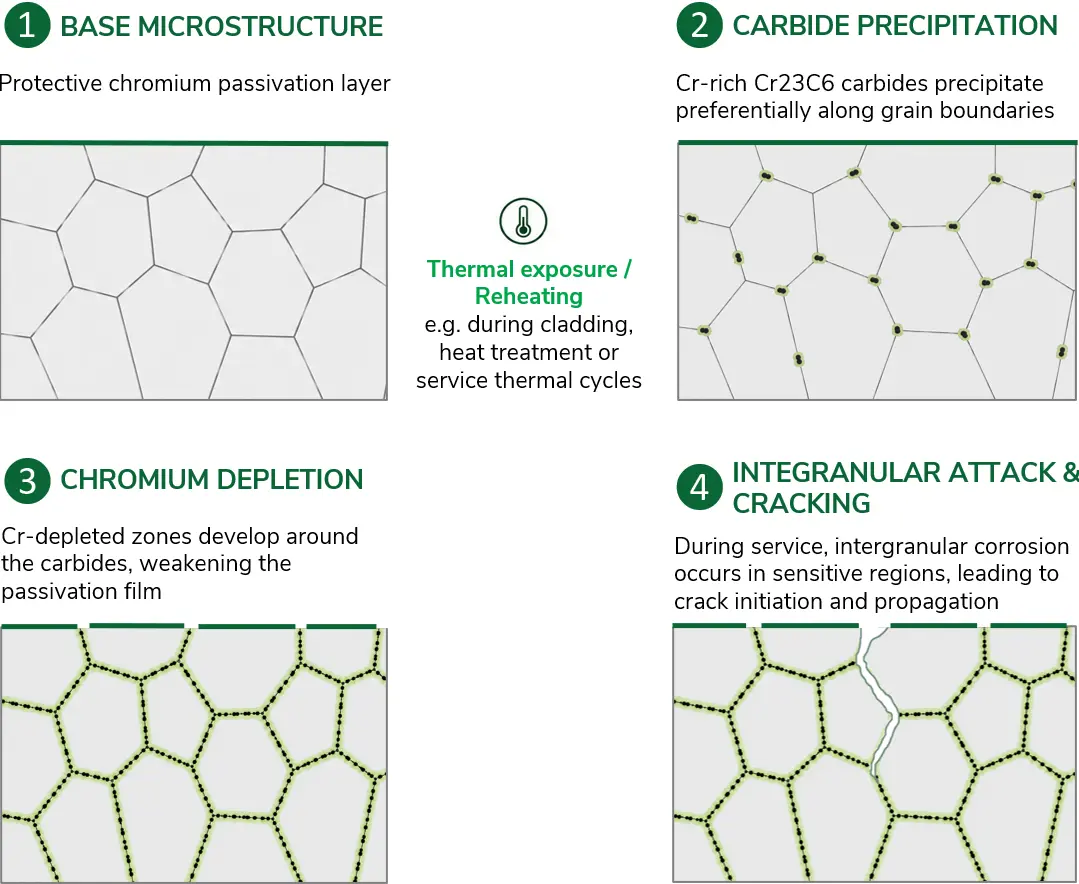
- Oxidation and corrosion also play an important role, particularly in areas combining elevated temperature and corrosive conditions. Chromium is essential in martensitic stainless steel overlays because sufficient chromium in the material enables the formation and maintenance of an oxide layer that acts as a protective passive film.
Corrosion resistance, however, depends not only on the nominal chromium content but also on its distribution within the microstructure. During welding, previously deposited material is reheated by following beads and layers. Excessive precipitation of chromium-rich carbides at the grain boundaries can produce chromium-depleted regions in the surrounding matrix, increasing susceptibility to localised corrosion and providing potential sites for crack initiation. This is one reason why carbon content is carefully controlled for martensitic
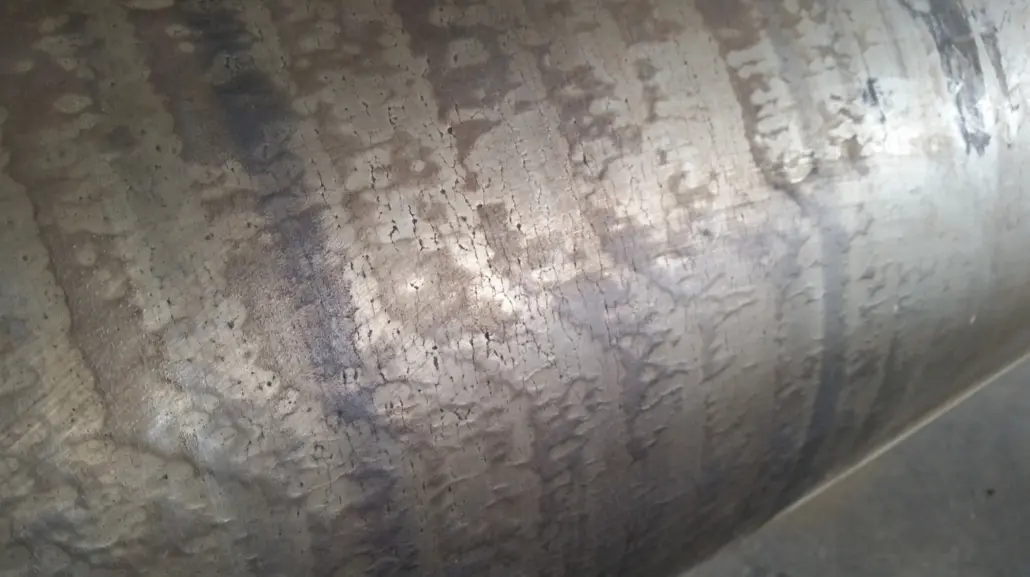
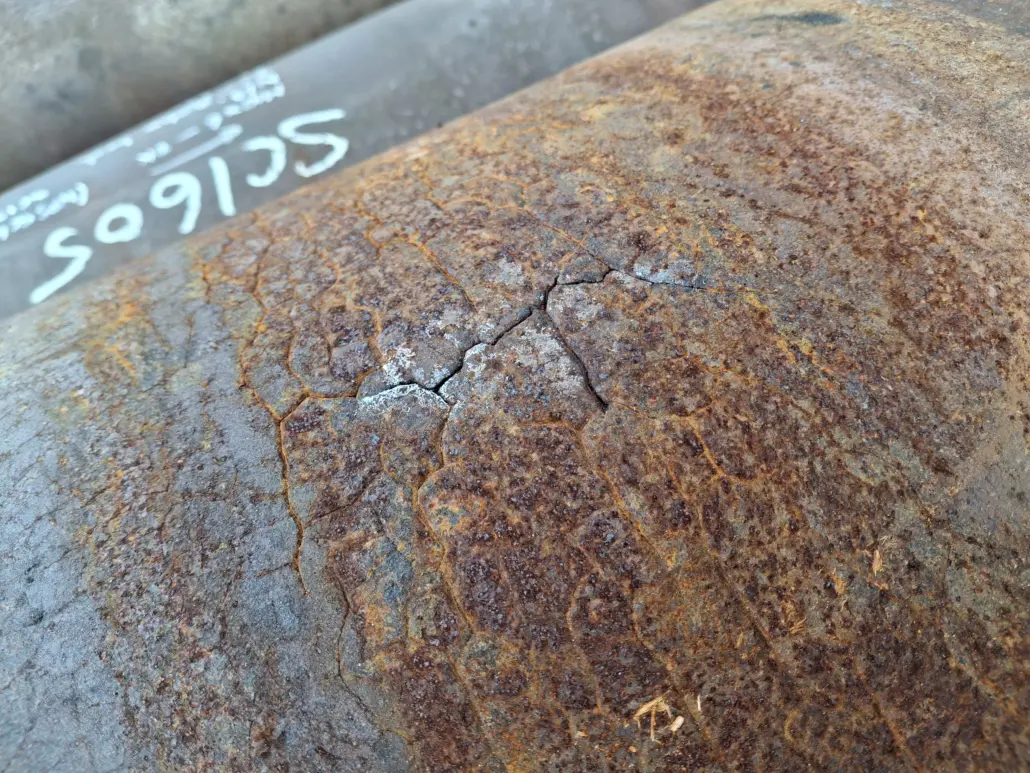
Examples of surface cracking caused by thermal fatigue on continuous casting rolls.
- Abrasive wear occurs when hard particles, particularly oxide scale and other solid debris are trapped between the roll and the backup roll, or between the roll and the slab. Under the high contact pressure applied, these particles act as abrasive elements, resulting in three-body abrasion and progressive material removal from the roll surface.
- Metal-to-metal and adhesive wear can also occur at the strand–roll interface. Under high contact pressures and elevated temperatures, combined with relative sliding movement, friction can promote micro-fusion between contacting asperities, leading to material transfer from the strand to the roll and consequently damage to its surface. The cladding material must therefore provide an appropriate balance of hardness, toughness, corrosion resistance and resistance to thermal fatigue, rather than simply the highest achievable hardness.
DIFFERENT AREAS, DIFFERENT REQUIREMENTS
The operating conditions vary considerably along the continuous casting line and place different demands on the cladding material.
- Foot rolls and upper segments: located immediately below the mould, these rolls operate close to the hottest part of the strand. The cladding therefore needs to resist thermal fatigue, oxidation and corrosion at elevated temperatures.
- Bow segment: further along the caster, resistance to thermal fatigue and corrosion remains important. The cladding must also resist wear, deformation and cracking under mechanical loading.
- Straightening and horizontal segments: further down the caster, mechanical loading, contact pressure and abrasion become more significant. The cladding requires sufficient hardness to resist wear and deformation while retaining adequate toughness and resistance to thermal fatigue.
This variation in operating conditions explains why different stainless steel cladding compositions have traditionally been used along the casting line. The effect of position on thermal cycling, oxidation/corrosion, mechanical stresses and abrasive loading is well established for continuous casting rolls.
MATCHING THE ALLOY TO THE APPLICATION
Different alloy systems are used along the caster to obtain the required balance between thermal, corrosion and mechanical properties.
For the foot rolls and upper segments, the severe thermal and corrosive conditions require a different metallurgical approach from the martensitic stainless steels used further down the caster. CORRESIST is a highly alloyed austenitic stainless steel, selected where resistance to oxidation and corrosion under elevated-temperature service conditions is particularly important.
In the bow segment, the required balance of properties changes. Resistance to thermal fatigue and corrosion remains important. The deposit must also resist wear, deformation and cracking under mechanical loading. CHROMECORE 414N is a relatively low-carbon 13% Cr martensitic stainless steel, alloyed with nitrogen and containing Ni and Mo, specifically developed for this application.
It combines the mechanical properties of a martensitic stainless steel material with the corrosion and thermal-fatigue resistance required for caster-roll service.
Nitrogen contributes to strengthening while allowing the carbon level to remain relatively low. Lower carbon content helps limit chromium-rich carbide precipitation, which can create chromium-depleted regions and reduce local corrosion resistance.
Nitrogen retained in solid solution can also influence the passivation behaviour of stainless steel. Its effect depends on the overall alloy composition and the associated precipitation behaviour, and should not be considered independently of the rest of the alloy design.
In the straightening and horizontal segments, mechanical loading, contact pressure and abrasion become increasingly important. CHROMECORE 414MM remains within the martensitic stainless steel family but uses a higher carbon content together with Mo and V to provide a harder deposit. Its typical as-welded hardness is 43–47 HRC, compared with 40–45 HRC for 414N.
The chemistry of the first deposited layer also requires particular attention. Continuous casting rolls are commonly manufactured from low- or medium-alloy steels, while the functional overlay is typically martensitic stainless steel. During welding, part of the roll substrate melts and mixes with the weld metal. This dilution reduces the concentration of chromium and alters the concentrations of other alloying elements in the first layer, meaning that the resulting deposit chemistry can differ significantly from the nominal composition of the consumable.
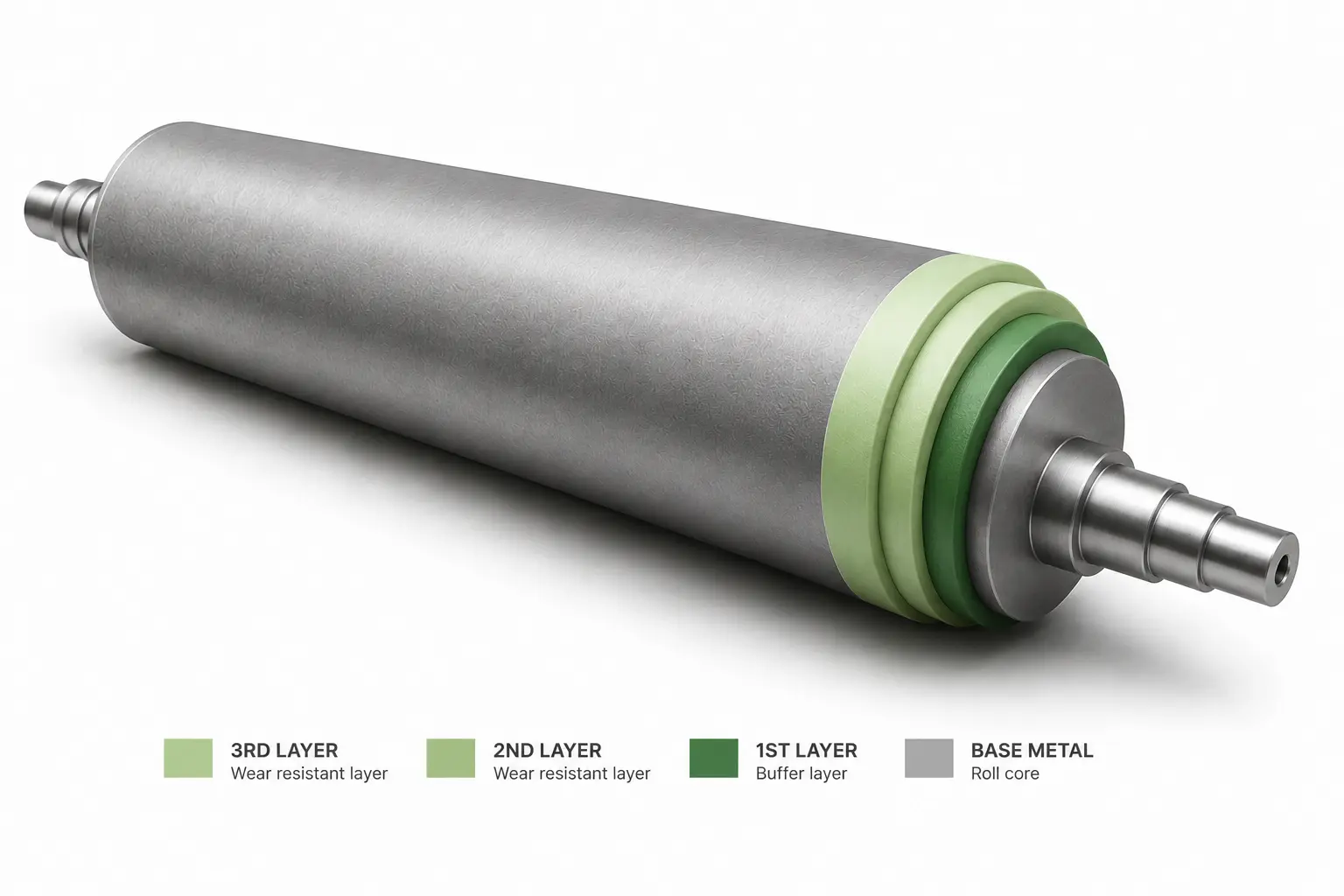
For this reason, CHROMECORE 434N, containing approximately 17% Cr, is used as a first layer when cladding low- or medium-alloy steel rolls with the 414 family. Its higher chromium content compensates for dilution from the substrate, helping the first layer achieve the intended composition before the subsequent martensitic stainless steel layers are deposited. The use of a 17% Cr buffer layer for this purpose is also recommended by Welding Alloys for martensitic stainless steel cladding on low- and medium-alloy steel substrates.
Foot rolls after casting 60,500 tonnes: CORRESIST cladding (top) compared with conventional martensitic stainless steel (bottom).
THE EVOLUTION TO CHROMECORE 414NX
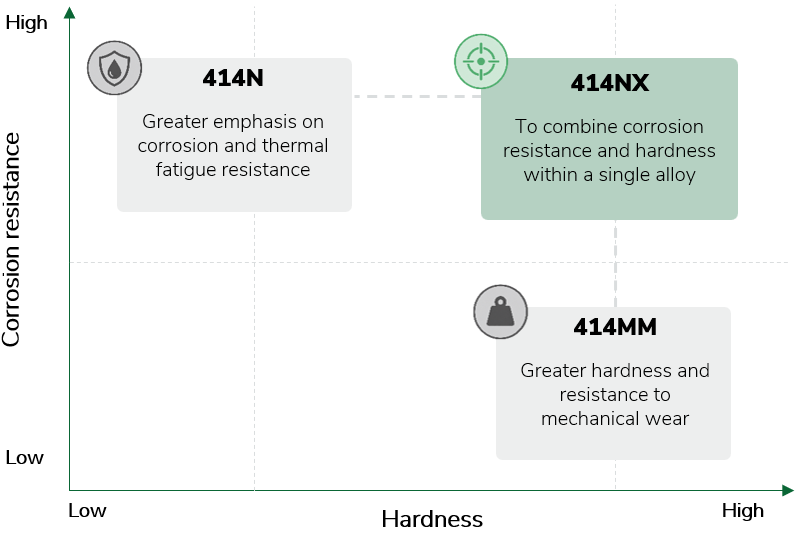
CHROMECORE 414N and CHROMECORE 414MM address different requirements along the continuous casting line. 414N is selected for its corrosion and thermal-fatigue resistance, while 414MM offers higher hardness for applications requiring greater wear resistance. CHROMECORE 414NX was developed to combine these properties within one alloy and extend the application range of a single consumable from the bow segments to the straightening and horizontal segments.
414NX is based on a low-carbon Cr-Ni-Mo martensitic stainless steel, additionally alloyed with nitrogen, niobium, vanadium and rare earth elements. The alloy design aims to maintain corrosion resistance while increasing hardness and resistance to softening during thermal exposure.
- The low carbon content limits excessive chromium carbide precipitation and the associated formation of chromium-depleted regions. This is important because such regions can become preferential sites for localised corrosion and crack initiation.
- Nitrogen contributes to strengthening while supporting the corrosion resistance of the stainless steel. Together with the low carbon content, it helps achieve the balance between mechanical properties and corrosion resistance required for continuous casting roll service.
- Niobium and vanadium are strong carbide-forming elements. Controlled additions contribute to strengthening and improved resistance to tempering, which is relevant for a surface repeatedly exposed to thermal cycles. The beneficial effect of controlled Nb and V additions on mechanical properties and tempering resistance has been demonstrated in low-carbon 12–13% Cr martensitic stainless steel overlays developed for continuous casting rolls.
- Rare-earth elements are also included in the 414NX formulation to promote microstructural refinement and modify the nature and morphology of non-metallic inclusions. The addition of rare earth elements also contributes to the mechanical and wear performance of the deposit.
The resulting deposit provides a balance between corrosion resistance, thermal-fatigue resistance, hardness and mechanical wear resistance, allowing 414NX to be used across a wider range of roll positions than either 414N or 414MM alone. Its typical as-welded hardness is 42–48 HRC for a three-layer deposit.
CONTROLLING DILUTION, LAYER BY LAYER
The performance of the roll cladding depends not only on the selected consumable but also on the chemistry actually obtained in the deposited layers. This is particularly important for the first layer, where dilution with the roll substrate has the greatest influence.
- In the conventional deposition sequence, CHROMECORE 434N is used as the first layer, followed by two layers of CHROMECORE 414NX. The higher chromium content of 434N compensates for dilution from the low- or medium-alloy steel substrate. With each subsequent layer, the influence of the substrate decreases and the deposit chemistry progressively approaches the target 414NX composition.
With this configuration, the measured chromium content increases from 11.40% in the first layer, to 12.77% in the second and 13.24% in the final layer, accompanied by increases in Ni and Mo. The nominal chemistry of a consumable is not necessarily the chemistry obtained in the first deposited layer. The substrate, consumable and welding procedure together determine the dilution rate and therefore the resulting deposit composition.
POST WELD HEAT TREATMENT (PWHT)
To achieve the required properties of the 414NX material, a PWHT is required to relieve the residual stresses generated during welding and to temper the martensitic microstructure.
The PWHT parameters are critical, as excessive temperatures can reduce the hardness of the deposited material. Different heat-treatment conditions were therefore evaluated to determine the most suitable PWHT parameters.
The selected procedure consists of a controlled heating rate of 50 °C/h to a temperature of 580 °C, followed by an 8 h holding time. A controlled cooling rate of 50 °C/h is then applied to minimise thermal shock and limit the development of additional residual stresses. With these parameters, the 414NX deposit achieves a hardness of 42–45 HRC after PWHT.
CONTROLLED AND REPEATABLE ROLL CLADDING
The roll cladding process requires good control of the welding parameters to ensure consistent dilution, bead overlap and deposit properties over the complete roll surface.
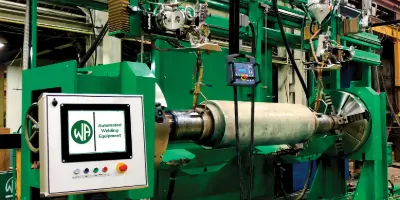
The Roll Cladder is an automated system designed for rebuilding and cladding steel mill rolls. Depending on the machine configuration, it can handle rolls up to 1, 3 or 6 tonnes and can be equipped with single or twin welding stations to increase deposition capacity.
Different welding processes can be used, including SAW for larger rolls and FCAW-S for smaller diameters where lower heat input may be required.
The D3 Touch control system synchronises roll rotation and welding head movement while controlling the welding sequence. Welding parameters and process data can also be recorded, providing traceability and helping to reproduce the same welding conditions from one roll to another.